Moving and Storage in Tifton, GA: How a Storage Unit Makes Your Move Easier
Moving is one of the most stressful events most families go through. Whether you are relocating across Tifton or moving to a new town entirely, the logistics of packing, timing closings and lease dates, and physically moving everything rarely line up perfectly. A storage unit gives you a place to put things when the timing is off — and in Tifton, Georgia, Hutchinson Self Storage is right here in Tift County to help you make that transition smoother.
This guide walks through how to use storage strategically during a move: when to rent, what to store, what size unit you need, and how to pack it so you can actually find things later.
Moving soon in Tifton? Check available units and sizes at our Tifton location.
View Tifton UnitsWhy a Storage Unit Helps During a Move
The core problem with most moves is that your old lease ends, or your old house closes, before your new place is ready. Even a one-week gap means your belongings need somewhere to go. A storage unit solves that problem cleanly.
Beyond timing gaps, storage helps in other ways during a move:
- Staging your home for sale. Real estate agents consistently recommend clearing out clutter before listing. Moving excess furniture and boxes into storage can make rooms photograph better and feel larger to buyers.
- Staggering the move. Instead of one overwhelming moving day, you can move non-essential items — seasonal gear, extra furniture, boxes — into storage over several weeks, then handle the essentials on a single day.
- Downsizing flexibility. If you are moving into a smaller home or waiting on a renovation, storage gives you a place to put things you are not ready to get rid of but cannot accommodate yet.
- Renovation buffer. If your new home needs work before you move in, a storage unit keeps your belongings safe and out of the way while contractors are there.
When to Rent Your Unit
The most common mistake people make is waiting too long. If you are renting a storage unit for a move, you want it in hand two to four weeks before your target move date. Here is why:
- You can start moving items you will not need before the move — off-season clothes, holiday decorations, extra kitchen gadgets, books — immediately. This steadily reduces the pile without the chaos of a single-day push.
- If your closing date or lease start shifts (and it often does), you already have a fallback. Scrambling to find a storage unit on short notice, especially a specific size, is a real risk in smaller markets.
- Packing is a lot less stressful when you can move boxes out of your home as you fill them, rather than stacking them in hallways for weeks.
Month-to-month rentals are the standard in self storage, so you are not locked in longer than you need. Rent it when you need it, vacate when you are settled.
What to Store and What to Keep Accessible
Not everything should go into storage during a move. A practical breakdown:
Good candidates for storage:
- Seasonal and outdoor items (lawn equipment, holiday decor, patio furniture)
- Extra or duplicate furniture you are not taking to the new place right away
- Boxes of books, records, photos, and other items you will not need during the transition
- Appliances that will not be used at the new home immediately
- Off-season clothing and sports or hobby equipment
Keep accessible — do not store these:
- Important documents (mortgage papers, birth certificates, insurance policies)
- Medications and medical equipment
- Daily-use clothing and toiletries
- Electronics you are actively using
- Children's school items and essentials
A simple rule: if you might need it in the next 30 days, keep it with you. Everything else is a candidate for the unit.
What Size Unit Do You Need?
Unit size is the question most people get wrong because they underestimate how much they own. A rough guide:
- 5x10 (50 sq ft): A small room's worth of boxes, a couple of chairs, small furniture pieces. Good for apartments or a single room from a larger home.
- 10x10 (100 sq ft): Contents of a one-bedroom apartment or two to three rooms from a larger home. Fits a sofa, dresser, boxes, and several medium furniture pieces.
- 10x15 (150 sq ft): A two-bedroom apartment or equivalent. Handles larger sofas, bed frames, dining sets, and boxes.
- 10x20 (200 sq ft): A two- to three-bedroom house. Fits major appliances, multiple bedroom sets, and a full household's worth of boxes.
- 10x30 (300 sq ft): A large home or a full household plus a vehicle. The largest standard unit size.
When in doubt, go one size up. Running out of space mid-move and needing a second unit is more disruptive than paying for a slightly larger unit from the start. Drive-up units at Hutchinson Self Storage allow you to pull your vehicle right to the door — a significant advantage when loading and unloading heavy furniture and stacks of boxes.
716 2nd Street East, Tifton, GA 31794. Call or rent online anytime.
Do You Need Climate Control?
South Georgia summers are hard on anything left in an unventilated space. Temperatures in Tifton regularly climb into the 90s from May through September, and humidity stays high most of the year. A standard drive-up unit is fine for items that can tolerate heat — tools, patio furniture, metal shelving, plastic bins.
For anything heat- or humidity-sensitive, a climate-controlled unit is worth the difference in price:
- Wood furniture (heat and humidity cause warping and joint separation)
- Upholstered sofas and mattresses (mold and mildew risk)
- Electronics and appliances
- Artwork, photographs, and documents
- Musical instruments and antiques
- Clothing stored long-term
If your move overlaps with summer — which is very common, since most leases and closings happen between May and August — think carefully about what is going into storage and for how long. A unit that sits through a Tifton July with furniture you plan to keep long-term warrants climate control.
How to Pack Your Unit for a Move
How you load a storage unit matters, especially if you need to access items before the move is complete.
- Label every box on the side, not the top. When boxes are stacked, you cannot see the top. Side labels mean you can read them without moving anything.
- Create an aisle down the middle. Load large furniture and items you will not need along the walls and back. Keep the center clear so you can walk in and reach anything without unloading the whole unit.
- Put frequently needed items near the door. If you are making multiple trips over several weeks, tools, a box of kitchen essentials, and seasonal items should be up front.
- Disassemble furniture. Bed frames, table legs, and shelving units take up far less space broken down. Keep hardware in a labeled bag taped to the main piece.
- Use furniture as shelving. Dressers can hold boxed items in their drawers. Wardrobes can hold hanging clothes. Use the vertical space your furniture creates.
- Stack heavy boxes on the bottom. Books and dense items go on the floor. Fragile and light items go on top.
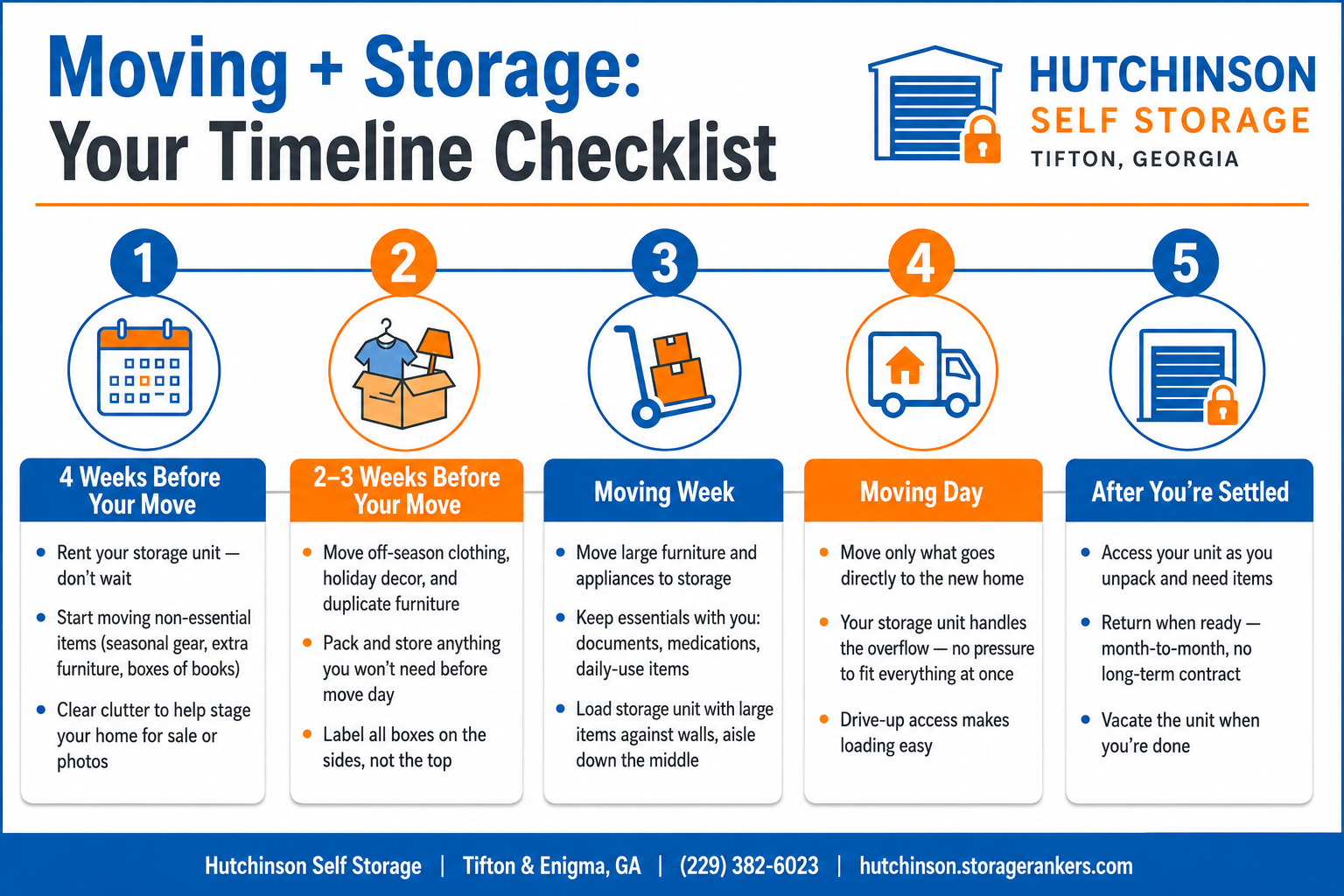
Moving Checklist: Storage Unit Timeline
The infographic below gives a visual summary of how to sequence your storage unit rental around your move.
Moving Within or To Tifton, GA
Tifton sits at the crossroads of I-75 and US 82, which makes it a natural hub for South Georgia moves. Families relocating from Valdosta, Albany, Moultrie, or from out of state frequently pass through or settle in Tift County. The area's combination of affordable housing, strong agricultural economy, and proximity to Georgia's major corridors makes it an active moving market.
Hutchinson Self Storage serves the Tifton area directly, with easy access from I-75 and US 82. Whether you are moving into a new home in Tifton, transitioning between rentals, or temporarily storing belongings while you get settled, we are a local, family-owned operation — not a national chain. You can reach a real person at (229) 382-6023 during business hours.